
Geopolitics Daily Brief — June 5, 2026
Five stories at 08:00 UTC: US-EU tariff and regulatory squeeze tightens on China ahead of July 24 deadline; Russia hits Zaporizhzhia as Ukraine destroys Donetsk drone base; Hezbollah rejects Lebanon ceasefire, keeping Iran deal prospects on ice; Taiwan plans 1,800-missile anti-ship arsenal; Brent holds $95.38 (+3.5% on week) on US payrolls watch.

Five stories at 08:00 UTC: Sino-West trade friction broadens; Russia pounds Zaporizhzhia as Ukraine destroys Donetsk drone base; Hezbollah torpedoes Lebanon ceasefire; Taiwan adds missiles faster than Beijing can count them; oil holds weekly gain on US jobs-day nerves.
1. US tariffs and EU rules tighten the vice on China
The USTR's Section 301 forced-labour investigation — formally proposed on 2 June — entered its public-comment period on Friday, with 10–12.5% additional tariffs targeting imports from 60 economies, China foremost among them.1 The European Union landed simultaneous pressure: the Industrial Accelerator Act and a new Cybersecurity Act both entered force this week, erecting tighter procurement standards that disproportionately affect Chinese tech and clean-energy suppliers.2 Beijing has warned of retaliation if the measures proceed as proposed.
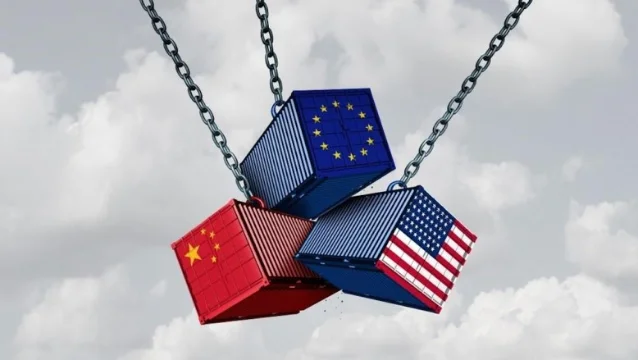
Market and supply-chain impact: Electronics, EVs, batteries, and pharma supply chains face the sharpest re-routing cost. Importers of Chinese-made battery packs are already seeing duty exposure of up to 69%, with OEM sourcing reviews accelerating.3 The convergence of US tariffs and EU regulatory barriers is narrowing the window for negotiated resolution before July 24, the USTR's implementation target date.2
2. Russia hits Zaporizhzhia again; Ukraine strikes Donetsk drone hub
Russian drones attacked Zaporizhzhia through the night of June 4–5, damaging a multi-storey residential building; the injury toll rose to 16 by Friday morning, including a nine-year-old girl.4 Separately, Russian forces fired 95 airstrikes using 289 guided aerial bombs and nearly 10,000 kamikaze drones over 24 hours, driving 273 combat engagements on the front line; the Pokrovsk and Huliaipole sectors absorbed the heaviest pressure.5
Ukraine's counter-move was precise: the 14th Regiment of the Unmanned Systems Forces executed what commanders called "the first such operation in modern history," systematically destroying Russia's Shahed-drone launch base at the occupied Donetsk Airport — hitting launch platforms, transport vehicles, fuel depots, ammunition stores, and the Rubikon drone unit's personnel.6
Market and supply-chain impact: Ongoing drone barrages on Zaporizhzhia's industrial zone — site of Europe's largest nuclear plant — keep European energy-risk premiums elevated. Ukraine's ability to neutralise forward drone infrastructure in Russian-held territory adds a new deterrence dimension but does not alter the fundamental tempo of Russian long-range strikes on grid and refining targets.
3. Hezbollah rejects Lebanon ceasefire; Iran ties it to any wider deal
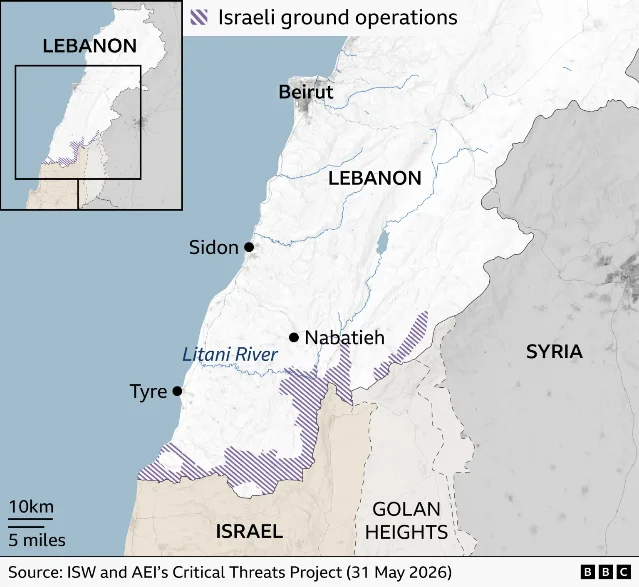
Hours after the US announced a new ceasefire framework on Wednesday night, Hezbollah's leader Naim Qassem called the agreement "futile and shameful," saying it amounted to surrender.7 The plan would require Hezbollah to halt all attacks and withdraw fighters north of the Litani River — currently under Israeli ground occupation — leaving Lebanese Armed Forces as the sole security presence. Israel's Defence Minister said ground operations would continue regardless.7
콘텐츠 카드를 불러오는 중…
Iran has explicitly linked any US-Iran nuclear deal to a Lebanon ceasefire, and warned it may intervene directly if Israeli advances continue; its IRGC demanded Israel withdraw to pre-March positions as a minimum condition.8 Lebanese Health Ministry figures put the death toll from the conflict at 3,526 since March 2; over one million have been displaced.7
Market and supply-chain impact: Oil slipped roughly 3% on Wednesday after the ceasefire was announced, but the reversal — Brent recovering to $95.38 by Friday (+3.5% week-on-week) — reflects how little confidence markets have in the framework holding.9 The Hormuz Strait remains effectively shut for normal transit; markets are treating full re-opening as a multi-month prospect at best even if a deal is reached.9
4. Taiwan targets 1,800-missile arsenal to repel any PLA blockade
Taiwan tracked 7 PLA aircraft (5 crossing into its southwestern air-defence identification zone) and 16 Chinese ships on Friday — a lower-than-peak day after 32 aircraft on June 4, but consistent with the grey-zone tempo of 64 aircraft sorties and 58 ship sightings already logged this month.10 Taiwan deployed aircraft, naval ships, and coastal missile systems in response.
The harder news is structural: Taipei Times reported this week that Taiwan plans to grow its anti-ship missile stockpile to over 1,800 by early 2029. The arsenal would combine 850 Boeing Harpoons (450 already delivered, 400 more from a $2.4bn 2020 Trump-era sale now arriving), roughly 100-plus domestically produced Hsiung Feng II and III missiles, and potentially 195 additional air-launched variants still under negotiation.11 A new Littoral Combat Command stands up on 1 July 2026 to integrate coastal radar, missiles, and drone units.
Market and supply-chain impact: The $2.4bn Harpoon sale and its follow-on packages represent active US defence industrial pipeline. For procurement and logistics managers, the standing-up of the Littoral Combat Command creates a new contracting entity and demand source for integrated coastal surveillance and drone-logistics systems across Taiwan's supply chain.
5. Oil holds weekly gain; markets await US payrolls
Brent crude held at around $95.38 on Friday (+0.4% on the day, +3.5% for the week) and US crude at $93.12 (+0.1%, +6.5% week-on-week), as Middle East ceasefire doubts persisted and traders held positions ahead of the US non-farm payrolls report due later today.9 Asian equities sold off: MSCI Asia ex-Japan fell 1.8%, Kospi dropped nearly 7%, the Nikkei 225 lost 1.6%; Nasdaq futures slipped 1.1% and S&P 500 futures fell 0.6%.9
The manufacturing outlook is also under pressure: industry forecasters cut 2026 global manufacturing growth to 2.6%, citing geopolitical disruption to semiconductor and energy supply chains.12 IMF analysis published this week warned that supply chains are now being rewired to optimise national security rather than cost, a structural shift with durable implications for procurement planning.
The key number to watch today: The US payrolls print — ADP beat expectations earlier this week; a strong number could push the Fed to hold rates longer, reinforcing the dollar and adding a financial-tightening dimension to already elevated energy and trade costs.
Sources: USTR, Asia Times, PIIE, Ukrinform, Kyiv Independent, BBC News, Reuters, Taiwan News, Taipei Times, Global Banking & Finance Review, Automation.com
참고 출처
- 1USTR proposes sweeping Section 301 tariffs
- 2Sino-West trade strains deepen on new tariffs and rules
- 3Battery pack tariffs: what OEMs need to know in 2026
- 4Injury toll in Russian drone attack on Zaporizhzhia rises to 16
- 5War update: 273 clashes on front line
- 6Ukraine destroys Russia's drone base at occupied Donetsk Airport
- 7Hezbollah rejects US-backed Israel-Lebanon ceasefire
- 8Hezbollah rejection clouds Lebanon ceasefire and prospects for ending Iran war
- 9Stocks drop as AI rally stalls, US-Iran peace talks remain unresolved
- 10Taiwan tracks 16 Chinese ships, 7 military aircraft
- 11Taiwan beefs up anti-ship missile arsenal
- 12Manufacturing industry growth downgraded to 2.6% amid geopolitical disruptions
이 콘텐츠를 둘러싼 관점이나 맥락을 계속 보강해 보세요.